Featured Snippet Answer
A cryogenic gate valve for LNG and LPG is a specially designed isolation valve that operates reliably at temperatures as low as -196°C (-320°F). It features an extended bonnet that keeps the stuffing box above -50°C, austenitic stainless steel body materials (ASTM A351 CF8M, CF3M, CF8C), and cavity pressure relief to prevent trapped liquid expansion. Key standards include BS 6364, MSS SP-134, and API 6D. The global cryogenic valve market reached 6.6billionin2025andisprojectedtoexceed10.6 billion by 2035, driven primarily by LNG infrastructure expansion.
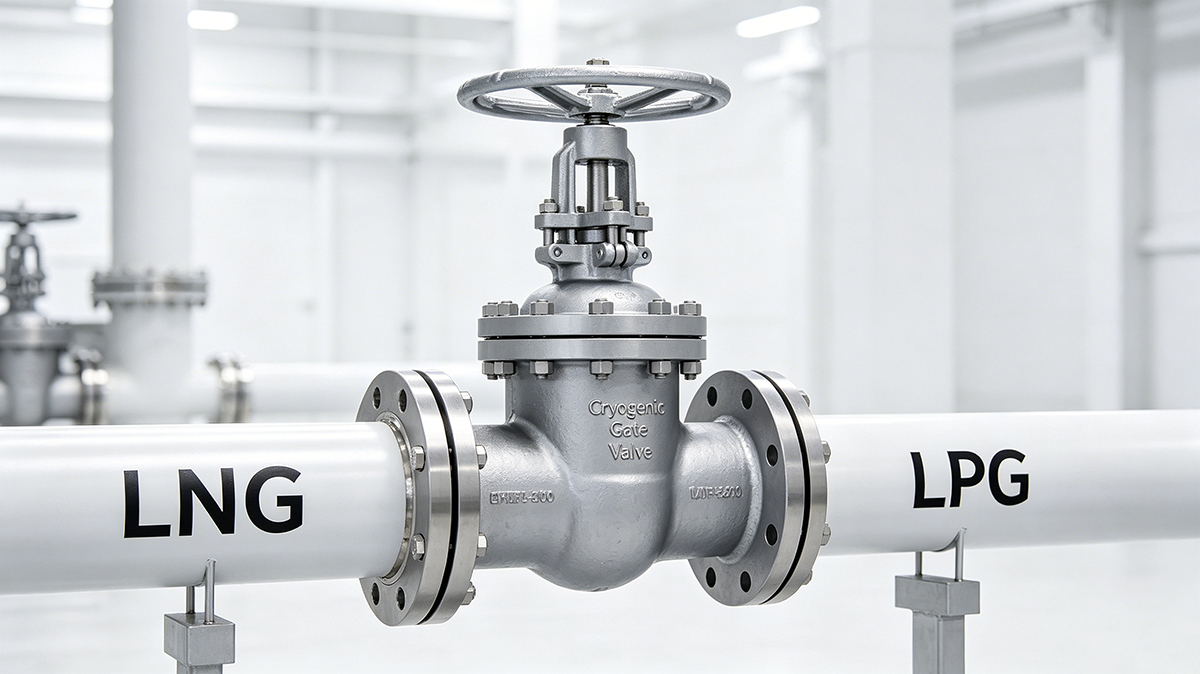
What Is a Cryogenic Gate Valve for LNG & LPG?
A cryogenic gate valve is a linear-motion isolation valve engineered for service temperatures from -46°C to -196°C. Unlike standard gate valves, it incorporates an extended bonnet, specialty austenitic materials, and cavity relief features to handle the extreme thermal and phase-change conditions of liquefied gas transport.
-
LNG (liquefied natural gas) is stored at approximately -162°C (-260°F) at atmospheric pressure
-
LPG (liquefied petroleum gas) is stored at -42°C to 0°C (-44°F to 32°F) depending on composition and pressure
-
Both media demand valves that resist brittle fracture, maintain seal integrity across massive thermal gradients, and prevent trapped liquid from hydrostatically over-pressurizing the valve cavity
-
Cryogenic gate valves are widely used in LNG liquefaction trains, receiving terminals, LPG fractionation plants, and cryogenic transport vessels
-
The extended bonnet design ensures the packing gland remains above -50°C, preserving PTFE or graphite seal elasticity
Understanding how cryogenic gate valves differ from conventional gate valves is the first step toward safe and specification-compliant low-temperature system design.
Types of Cryogenic Gate Valve for LNG & LPG
Cryogenic gate valves are classified by wedge design, bonnet construction, end connection, and seat configuration. Each variant addresses specific installation, maintenance, and performance requirements in low-temperature gas processing.
By Wedge Design
|
Type
|
Description
|
Best For
|
|
Solid wedge
|
Single-piece wedge, simplest construction
|
LPG service above -46°C
|
|
Flexible wedge
|
Center slot allows angular adjustment
|
LNG service with thermal cycling
|
|
Split wedge
|
Two-piece discs expand against seats
|
High-seal-integrity LNG isolation
|
By Bonnet Construction
|
Type
|
Description
|
Best For
|
|
Bolted bonnet with extended stem
|
Standard maintenance access; bonnet bolts remain at ambient
|
Most LNG/LPG isolation duties
|
|
Pressure seal bonnet with extension
|
Higher pressure classes (Class 600+); compact
|
High-pressure LNG pump discharge
|
|
Welded bonnet
|
Zero body-to-bonnet leakage path; non-repairable in-line
|
Cold box and vacuum-jacketed piping
|
By End Connection
|
Type
|
Description
|
Best For
|
|
Butt-weld (BW)
|
Leak-free, full-penetration weld
|
LNG pipelines and permanent installations
|
|
Flanged (RF/RTJ)
|
Bolted flange per ASME B16.5
|
LPG plants, maintenance-critical lines
|
|
Socket-weld (SW)
|
Small bore ≤ 2" NPS
|
Instrument and drain connections
|
By Seat Configuration
|
Type
|
Description
|
Best For
|
|
Metal-to-metal
|
Hard-faced seats (Stellite 6 / 13)
|
LNG, frequent thermal cycling
|
|
Soft-seated with metal backup
|
PTFE/PEEK primary + metal backup
|
LPG, bubble-tight shutoff required
|
Selecting the right combination of wedge, bonnet, end connection, and seat type is critical to matching valve performance to the specific cryogenic application.
Key Design Features and Specifications
Cryogenic gate valves incorporate several specialized design elements that distinguish them from standard-temperature gate valves. These features ensure operability, safety, and long-term reliability at temperatures where most carbon steels become dangerously brittle.
Extended Bonnet (Stem Extension)
-
The extended bonnet creates a thermal barrier between the cryogenic process and the packing gland
-
BS 6364 mandates minimum extension lengths based on valve type and nominal size:
-
Gate valve DN50: minimum 600 mm extension
-
Gate valve DN100: minimum 700 mm extension
-
Gate valve DN200: minimum 900 mm extension
-
Gate valve DN300: minimum 1,100 mm extension
-
For non-cold-box applications, the minimum extension length is 250 mm
-
The stem extension must be seamless tube welded to the bonnet and stuffing box for structural integrity
Cavity Pressure Relief
-
When a closed gate valve traps cryogenic liquid between the seats, heat ingress causes the liquid to expand and vaporize
-
Without relief, internal pressure can exceed the body rating and cause catastrophic failure
-
Relief methods include:
-
A drilled hole through the upstream wedge face
-
A relief channel machined into the body cavity
-
An external relief valve piped to the upstream side
-
BS 6364 requires that cavity relief defaults to the upstream side unless the purchaser specifies otherwise
Material Requirements (BS 6364 / MSS SP-134)
-
Only austenitic stainless steels and certain nickel alloys are acceptable for cryogenic service
-
Ferritic and martensitic steels undergo ductile-to-brittle transition at low temperatures and must not be used
-
BS 6364 Appendix B preferred austenitic materials:
|
Form
|
ASTM Specification
|
Grade
|
Temperature Limit
|
|
Cast
|
A351
|
CF3
|
-196°C (welded end)
|
|
Cast
|
A351
|
CF3M
|
-196°C (welded end)
|
|
Cast
|
A351
|
CF8M
|
-196°C (flanged only)
|
|
Cast
|
A351
|
CF8C
|
-196°C (welded end)
|
|
Forged
|
A182
|
F304L
|
-196°C (welded end)
|
|
Forged
|
A182
|
F316L
|
-196°C (welded end)
|
|
Forged
|
A182
|
F347
|
-196°C (welded end)
|
-
Bolting must comply with BS 4882; note that austenitic bolts experience permanent dimensional increase on first cool-down to -196°C, potentially reducing pre-load
-
Packing materials: PTFE or graphite, with anti-extrusion rings; lantern rings and threaded plug packings are prohibited by BS 6364
Operational Force Limits
-
BS 6364 limits manual operation force to 350 N at the handwheel rim during normal operation
-
Seat unseating force may reach 500 N maximum
-
These limits ensure operators can actuate the valve even with ice accumulation on the handwheel
Design features like extended bonnets, cavity relief, and austenitic materials are not optional upgrades—they are mandatory safety requirements for any gate valve in cryogenic LNG or LPG service.
Applications of Cryogenic Gate Valves
Cryogenic gate valves serve critical isolation functions across five major industries. Each application presents unique temperature, pressure, and operational demands that influence valve specification.
LNG Liquefaction and Regasification
-
Liquefaction trains operate at -162°C to convert natural gas into LNG for transport
-
Regasification terminals receive LNG, store it in cryogenic tanks, and vaporize it back into pipeline gas
-
Gate valves isolate LNG transfer lines, pump suction headers, and tank inlet/outlet connections
-
Typical size range: 2" to 36"; Class 150 to Class 600
-
The global LNG market is projected to reach $87.4 billion by 2030, directly driving cryogenic valve demand
LPG Storage and Distribution
-
LPG (propane/butane mix) is stored at -42°C to ambient temperature under moderate pressure
-
Gate valves are used on LPG sphere drains, transfer manifolds, and marine loading arms
-
Material requirements are less severe than LNG; CF8M or F316 are commonly specified
-
Typical size range: 2" to 24"; Class 150 to Class 300
Industrial Gas Production
-
Air separation units (ASU) produce liquid nitrogen (-196°C), liquid oxygen (-183°C), and liquid argon (-186°C)
-
Gate valves isolate cryogenic pump circuits and cold box internal piping
-
All-metal seats are preferred due to oxygen service fire risk with PTFE
-
Typical size range: 1" to 12"; Class 150 to Class 300
Ethylene and Petrochemical Plants
-
Ethylene is stored at approximately -104°C in low-temperature tanks
-
Gate valves isolate ethylene refrigeration loops, cracked gas chillers, and cold fractionation columns
-
Impact-tested carbon steel (LCC/LCB) may suffice above -46°C; austenitic stainless required below
-
Typical size range: 2" to 30"; Class 150 to Class 600
LNG Bunkering and Marine Fuel
-
LNG-fueled vessels and bunkering infrastructure require cryogenic valves for fuel supply systems
-
Classification societies (DNV, Lloyd's Register, Bureau Veritas) impose additional type-approval requirements
-
Valves must survive thermal shock during emergency shutdown (ESD) scenarios
-
Typical size range: 1" to 8"; Class 150 to Class 300
Each application requires careful matching of material grade, seat type, and bonnet extension length to the specific cryogenic fluid and operating envelope.
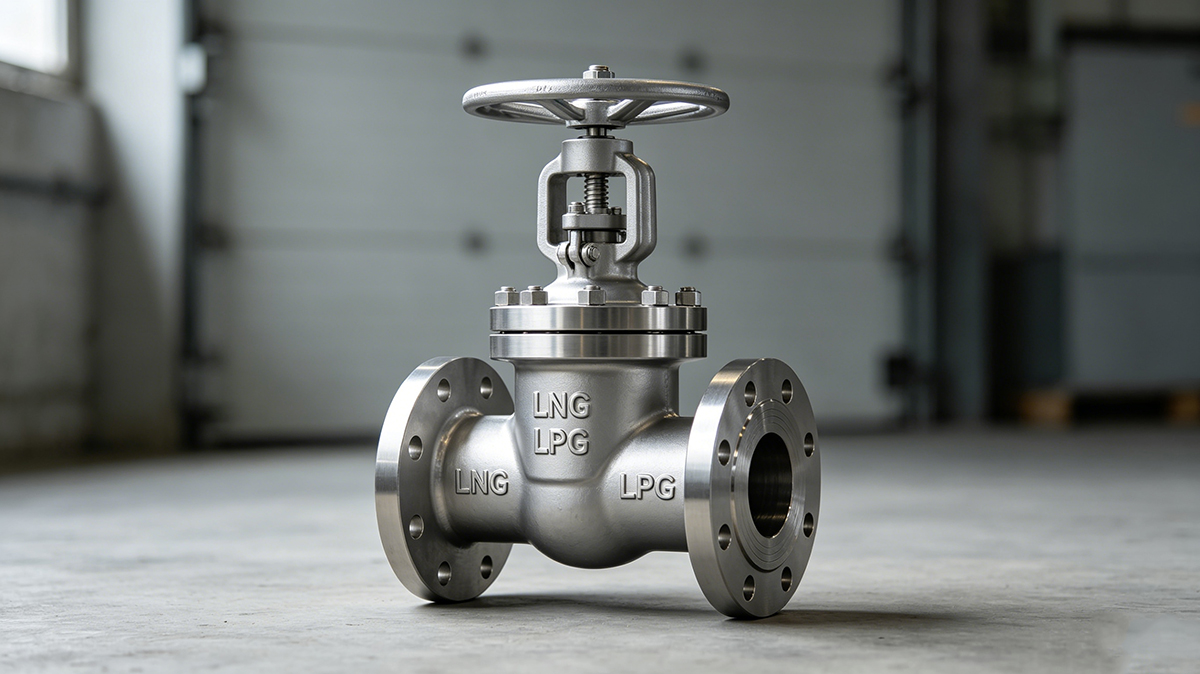
How to Choose a Cryogenic Gate Valve for LNG & LPG
Specifying a cryogenic gate valve requires attention to eight critical parameters. An error in any one of these can lead to valve failure, safety incidents, or costly project delays.
-
Confirm the minimum design temperature
-
LPG above -46°C may permit impact-tested carbon steel (LCB/LCC per ASTM A352)
-
LNG at -162°C and liquid nitrogen at -196°C mandate austenitic stainless (CF3M/CF8C/F316L)
-
Always include a margin of at least 10°C below the lowest expected operating temperature
-
Select the correct material grade
-
Welded-end applications: CF3, CF3M, or CF8C (ASTM A351) for cast bodies; F304L, F316L, or F347 (ASTM A182) for forged bodies
-
Flanged-only applications: CF8M is acceptable but lacks the superior corrosion resistance of CF3M
-
Verify Charpy V-notch impact test compliance per ASTM A351 Supplementary Requirement S5
-
Specify the bonnet extension length per BS 6364
-
Undersized extensions allow frost or ice to reach the packing gland, causing leakage
-
For cold-box installations, the valve stem must be at least 15° above horizontal
-
Verify extension length against BS 6364 Table for the specific valve type and nominal size
-
Define the cavity pressure relief method
-
Standard: upstream relief hole through the wedge
-
Alternative: external relief valve piped to the upstream piping
-
Document the relief direction in the valve data sheet to prevent installation errors
-
Choose the appropriate seat configuration
-
Metal-seated (Stellite 6 overlay): preferred for LNG and oxygen service; fire-safe; resists thermal cycling wear
-
Soft-seated (PTFE/PEEK with metal backup): acceptable for LPG where bubble-tight shutoff is required
-
Confirm fire-test compliance per API 607 / ISO 10497 if fire safety is a project requirement
-
Verify compliance with applicable standards
-
BS 6364: primary international standard for cryogenic valve design, testing, and materials
-
MSS SP-134: North American cryogenic valve specification (complementary to BS 6364)
-
API 6D: pipeline valve specification; applicable for LNG pipeline isolation valves
-
API 600: gate valve design standard; referenced for body/bonnet construction
-
ASME B16.34: pressure-temperature rating basis
-
ISO 15848-1: fugitive emission requirements (increasingly specified for LNG terminals)
-
Determine the end connection type
-
Butt-weld: preferred for LNG pipelines; eliminates flange leak paths at cryogenic temperatures
-
Flanged (RTJ): required where in-line maintenance access is a priority; use spiral-wound gaskets with austenitic windings
-
Socket-weld: limited to small-bore (≤ 2") instrument connections
-
Plan for cryogenic type testing
-
BS 6364 Appendix A cryogenic testing is mandatory for marine service
-
For land-based LNG/LPG applications, specify type testing on the purchase order
-
Test media: liquid nitrogen at -196°C; measure seat leakage rate and operating torque
-
Metal-seated valve maximum allowable leakage: 0.3 mm³/s per DN
A correctly specified cryogenic gate valve balances material suitability, standard compliance, and operational safety at temperatures where design errors have immediate and severe consequences.
Cryogenic Gate Valve Manufacturers
The cryogenic gate valve market is served by a mix of global industrial valve manufacturers and specialized cryogenic valve suppliers. The following manufacturers have established track records in LNG and LPG applications.
|
Manufacturer
|
Headquarters
|
Cryogenic Specialization
|
Notable Certifications
|
|
Velan
|
Canada
|
Forged cryogenic gate, globe, and check valves to -196°C
|
BS 6364, MSS SP-134, API 600
|
|
L&T Valves
|
India
|
BS 6364 gate valves 2"–54", Class 150–2500
|
Shell DEP 77/300, ISO 15848-1
|
|
Neway Valve
|
China
|
Stainless steel cryogenic gate valves, -196°C rated
|
API 600, API 6D, CE, SIL
|
|
Smith Valve
|
USA
|
Forged cryogenic gate/globe/check, ASME Class 150–2500
|
MSS SP-134, BS 6364
|
|
Cotswold Valve
|
UK
|
Cryogenic gate valves for LNG and industrial gas
|
BS 6364, ISO 17292
|
|
Dahui Valve
|
China
|
Cryogenic gate valves for LNG/LPG with extended bonnets
|
BS 6364, MSS SP-134, API 600
|
When evaluating manufacturers, prioritize documented cryogenic type test results, third-party inspection records, and project references from operating LNG terminals or LPG facilities over catalogue claims alone.
Cost and Pricing of Cryogenic Gate Valves
Cryogenic gate valve pricing is significantly higher than standard-temperature equivalents due to austenitic material costs, extended bonnet fabrication, and mandatory cryogenic testing. The following table provides indicative 2026 FOB price ranges.
2026 FOB Price Ranges by Size and Material
|
Size
|
Class
|
Body Material
|
Seat Type
|
FOB Price Range (USD)
|
|
2"
|
150
|
A351 CF3M
|
Metal (Stellite)
|
800–1,500
|
|
2"
|
300
|
A351 CF3M
|
Metal (Stellite)
|
1,200–2,000
|
|
4"
|
150
|
A351 CF8M
|
Metal (Stellite)
|
2,000–3,500
|
|
4"
|
600
|
A351 CF3M
|
Metal (Stellite)
|
4,500–7,000
|
|
6"
|
150
|
A351 CF8C
|
Metal (Stellite)
|
3,500–5,500
|
|
6"
|
300
|
A351 CF3M
|
Metal (Stellite)
|
5,000–8,500
|
|
8"
|
150
|
A351 CF8M
|
Metal (Stellite)
|
5,500–9,000
|
|
8"
|
600
|
A351 CF3M
|
Metal (Stellite)
|
10,000–16,000
|
|
12"
|
150
|
A351 CF8C
|
Metal (Stellite)
|
9,000–15,000
|
|
12"
|
600
|
A351 CF3M
|
Metal (Stellite)
|
18,000–28,000
|
|
16"
|
300
|
A351 CF3M
|
Metal (Stellite)
|
22,000–35,000
|
|
24"
|
150
|
A351 CF8M
|
Metal (Stellite)
|
25,000–45,000
|
Key Cost Drivers
-
Material grade: CF3M and CF8C cost 15–25% more than CF8M due to lower carbon content and niobium stabilization
-
Bonnet extension: Each 100 mm of additional extension adds approximately 5–8% to the base valve cost
-
Cryogenic type testing: BS 6364 Appendix A testing adds 2,000–5,000 per order (not per valve) when performed at a certified laboratory
-
Pressure class: Moving from Class 150 to Class 600 roughly doubles the price; Class 1500 can increase it 4–5x
-
Carbon steel vs. austenitic stainless: Impact-tested carbon steel (LCB/LCC) valves for LPG service above -46°C cost 40–50% less than equivalent austenitic stainless valves
-
Order volume: Project quantities of 50+ units typically receive 10–18% discount from FOB list price
H3: Total Landed Cost Example
-
10× 6" Class 300 A351 CF3M cryogenic gate valves for an LNG terminal
-
FOB unit price: 6,500→FOBtotal:65,000
-
Cryogenic type testing: $4,000
-
Third-party inspection (TPI): $3,500
-
Freight (CIF Middle East): $4,200
-
Import duties (5%): $3,260
-
Total landed cost: 79,960(≈7,996 per valve)
Budgeting for cryogenic gate valves must account for material premiums, mandatory testing, and logistics surcharges that can add 20–30% above the base FOB price.
2026 Market Trends and Outlook
The cryogenic gate valve market is expanding rapidly, driven by global LNG infrastructure investment, clean energy transition policies, and the emergence of new cryogenic applications.
-
Global cryogenic valve market: valued at 6.6billionin2025,projectedtoreach10.6 billion by 2035 at a CAGR of 4.9%
-
Cryogenic gate valve segment: growing at 6.8% CAGR; gate valves maintain over 35% market share in the LNG cryogenic valve segment due to reliable isolation performance
-
LNG cryogenic valve sub-market: valued at 334millionin2024,expectedtoreach1.2 billion by 2034
-
Key growth drivers:
-
Global LNG trade reached 404 million tonnes in 2025, with 180+ new LNG terminals planned or under construction through 2030
-
Over 50 countries now import LNG, up from 40 in 2020, expanding the geographic demand base for cryogenic valves
-
LNG bunkering for marine fuel is growing at 15–20% annually as IMO sulfur regulations drive fuel switching
-
Hydrogen liquefaction (at -253°C) is an emerging frontier that will require next-generation cryogenic valves beyond current -196°C ratings
-
Regional trends:
-
Asia-Pacific: accounts for 38% of cryogenic valve demand, driven by China, Japan, South Korea, and India LNG import growth
-
Middle East: Qatar's North Field Expansion (48 MTPA) and new Qatari LNG trains are the single largest demand driver for large-bore cryogenic gate valves
-
North America: U.S. Gulf Coast LNG export terminals continue to drive specification-grade cryogenic valve procurement
-
Technology trends:
-
Digital twin integration: RFID-tagged valves (e.g., L&T ValvTrac™) enable lifecycle tracking from factory to maintenance
-
Low-emission packing: ISO 15848-1 compliance is now specified on 60%+ of new LNG terminal projects
-
Automated cryogenic gate valves with electric or pneumatic actuators are replacing manual operators on ESD systems
The convergence of LNG capacity expansion, clean energy policy, and digital valve management is creating sustained demand growth and specification evolution in the cryogenic gate valve market through 2035.
FAQ
Q: What is the minimum temperature rating for a cryogenic gate valve?
A: Cryogenic gate valves designed to BS 6364 are rated for service from -50°C to -196°C. LNG service typically requires -162°C to -170°C capability. Liquid nitrogen and liquid helium applications demand -196°C or lower. For LPG service above -46°C, impact-tested carbon steel (ASTM A352 LCB/LCC) may be used instead of austenitic stainless steel.
Q: Why does a cryogenic gate valve need an extended bonnet?
A: The extended bonnet creates a thermal gradient that keeps the packing gland and stem above -50°C, even when the process fluid is at -196°C. Without this extension, frost and ice would form at the packing, causing seal hardening, leakage, and potential binding of the stem. BS 6364 specifies minimum extension lengths based on valve type and nominal size.
Q: What materials are used for cryogenic gate valves in LNG service?
A: Austenitic stainless steels are the standard materials for LNG gate valves because they do not undergo ductile-to-brittle transition at cryogenic temperatures. Common grades include ASTM A351 CF3M (cast) and ASTM A182 F316L (forged) for welded-end valves. ASTM A351 CF8C (stabilized with niobium) is used for welded-end applications requiring intergranular corrosion resistance after welding.
Q: What is cavity pressure relief and why is it required?
A: When a cryogenic gate valve is closed with liquid trapped between the seats, heat ingress causes the liquid to expand and vaporize, generating pressures that can exceed the valve body rating. Cavity pressure relief—typically a hole drilled through the upstream wedge face—allows expanding fluid to escape into the upstream piping. BS 6364 requires this feature on all gate valves in cryogenic service.
Q: Can carbon steel be used for cryogenic gate valves?
A: Impact-tested carbon steel (ASTM A352 LCB for -46°C, LCC for -59°C) can be used for LPG service above -46°C and certain refrigeration applications. Carbon steel must never be used for LNG service at -162°C because ferritic and martensitic steels undergo ductile-to-brittle transition, creating a risk of catastrophic brittle fracture.
Q: What testing is required for cryogenic gate valves?
A: BS 6364 requires shell strength testing, shell leakage testing (using dry oil-free air or nitrogen), and seat leakage testing at ambient temperature. For marine service, cryogenic prototype testing at -196°C per BS 6364 Appendix A is mandatory. For land-based applications, type testing should be specified on the purchase order. Metal-seated valve seat leakage must not exceed 0.3 mm³/s per DN.
Q: How does a cryogenic gate valve differ from a standard gate valve?
A: Key differences include: (1) austenitic stainless steel body/bonnet instead of carbon steel, (2) extended bonnet to maintain packing temperature, (3) cavity pressure relief to prevent hydrostatic over-pressurization, (4) special packing materials (PTFE/graphite with anti-extrusion rings), (5) prohibition of threaded bonnet connections, and (6) mandatory cryogenic type testing for critical applications.
Q: What is the typical lead time for cryogenic gate valves?
A: Lead times range from 12 to 24 weeks depending on size, material, and testing requirements. Standard sizes (2"–6") in CF3M with Class 150–300 typically ship in 12–16 weeks. Large-bore valves (12"+), high-pressure classes (Class 600+), or orders requiring BS 6364 Appendix A type testing can extend to 20–24 weeks. Custom extensions and special trim requirements add 4–6 weeks.
CTA
Selecting the right cryogenic gate valve for LNG or LPG service demands precision in material specification, standard compliance, and thermal design. Whether you are engineering an LNG receiving terminal, specifying LPG storage isolation, or upgrading a cryogenic distribution system, working with an experienced valve manufacturer reduces project risk and accelerates delivery.
For BS 6364 and MSS SP-134 compliant cryogenic gate valves with full type-test documentation, contact the engineering team at chlgvalve.com.

