

Date:2026-06-09 Views:30
Pressure testing a Stainless Steel Cryogenic Gate Valve is not a single-step operation. It follows a structured sequence — ambient-temperature shell and seat verification followed by a dedicated low-temperature functional and seat leakage assessment — because a valve that seals at room temperature can behave very differently at service conditions approaching −196 °C. The standards that govern this sequence sit at the intersection of generic valve pressure testing codes and cryogenic-specific design specifications.
Four documents form the backbone of pressure testing practice for cryogenic gate valves:
| Standard | Scope |
|---|---|
| API 598 | General valve inspection and testing — shell, seat, backseat tests with ambient-temperature fluid |
| BS 6364 | Design, manufacture, and testing of valves for cryogenic service (temperatures −50 °C to −196 °C); references testing methodology proportionate to rated class |
| EN 1626 | Design, manufacture, and testing of valves for cryogenic service (below −10 °C); European complement to BS 6364 with additional low-temperature verification protocols |
| MSS SP-134 | Design requirements for valves in cryogenic service, including body/bonnet extension provisions |
In addition, EN 12266-1 (which superseded BS 6755 and aligns with ISO 5208) specifies the leakage rate classes that acceptance criteria reference, and ISO 28921 provides further guidance on isolating valves intended for low-temperature operation.
The sequence prescribed across these documents can be summarized as: shell integrity at ambient temperature → ambient seat and backseat tightness → full cryogenic cool-down and functional cycling → cryogenic seat leak rate measurement.
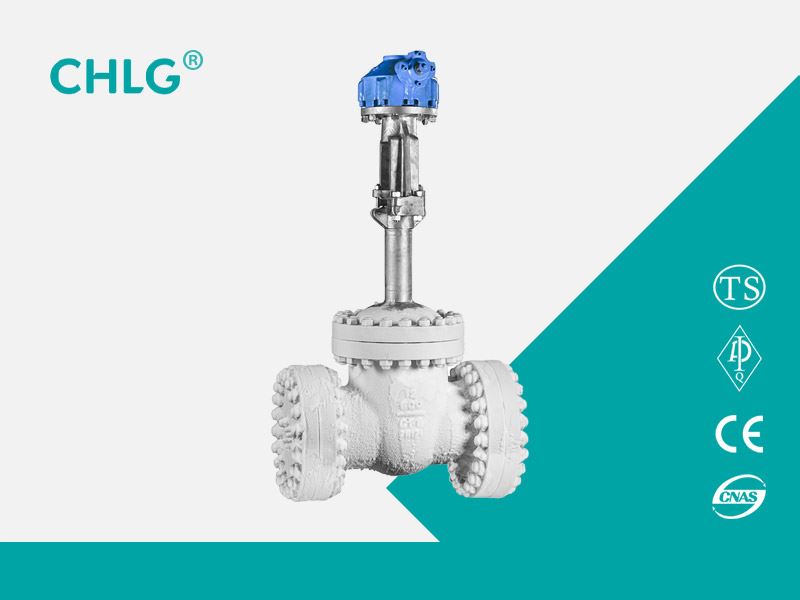
The shell test is a body-strength verification, not a seat performance check. Per API 598, a Stainless Steel Cryogenic Gate Valve must withstand a hydrostatic pressure equal to 1.5 times the maximum rated pressure at 38 °C (100 °F) for its given pressure class, with the value rounded up to the next integer bar — or 25 psi increment for Class-rated products.
The valve is mounted with ends closed, placed in the partially-open position, and any applicable packing gland is tightened. Water (typically with a corrosion inhibitor) is the standard medium. Minimum hold times are size-dependent:
| Valve DN (NPS) | Minimum Shell Test Duration |
|---|---|
| ≤ 50 (≤ 2 in) | 15 seconds |
| 65–150 (2½–6 in) | 60 seconds |
| 200–300 (8–12 in) | 120 seconds |
| ≥ 350 (≥ 14 in) | 300 seconds |
Source: API 598, 2023 Edition — Table 4
No visible leakage through the pressure boundary is permitted. Any measurable leak or structural deformation constitutes failure.
Once shell integrity is confirmed, the closure element is tested in both the high-pressure and low-pressure regimes.
High-pressure seat test: API 598 specifies a test pressure of 1.1 times the maximum cold working pressure at 38 °C. The medium is typically water. For a gate valve, pressure is applied sequentially to each side of the closed wedge, with the opposite side vented to atmosphere, ensuring both upstream and downstream sealing directions are verified independently.
Low-pressure seat test: Conducted at 5.5 ± 1.5 bar (80 ± 20 psi) using air or nitrogen as the test medium. This stage reveals micro-leakage paths that a high-pressure liquid test might mask through viscous sealing effects.
Backseat test (backseat-equipped designs): Where the valve includes a backseat feature — common in cryogenic gate valve bonnet designs — the stem is fully retracted and a test at 1.1 times rated pressure is applied while the packing gland is loosened. No leakage is permitted at the packing.
Metal-seated cryogenic gate valves are subject to the allowable leakage rates tabulated in API 598 Table 5, which scale with valve size. For context, a DN 150 (NPS 6) metal-seated gate valve permits a maximum of 12 drops per minute on liquid testing and 24 bubbles per minute on gas testing. For a DN 50 (NPS 2) valve, the standard sets a zero-leak threshold — no visible liquid leakage and fewer than one bubble during the full test duration.
Source: API 598, 2023 Edition — Tables 3, 4, and 5
The phase that distinguishes a Stainless Steel Cryogenic Gate Valve from a standard industrial gate valve is the low-temperature test. BS 6364 requires that the complete valve — assembled with its extended bonnet, stem, packing, and body-bonnet joint — be subjected to a controlled cryogenic cool-down cycle reaching temperatures of at least −196 °C when liquid nitrogen is used as the cooling medium (or the specific minimum design temperature specified by the service conditions if less severe).
The cooling process follows a deliberate thermal ramp. The valve is placed in a test fixture, connected to the pressurizing circuit, and the entire closure assembly is exposed to cryogenic fluid. A thermocouple array monitors the body, bonnet flange, and stem packing zone simultaneously. Testing cannot begin until thermal stabilization is confirmed across all monitoring points — typically indicated when temperature variation across the monitored locations falls below a specified threshold over a defined interval.
Once thermal equilibrium is reached, the valve is operated — fully opened and fully closed — across a minimum number of cycles while at low temperature, with the required cycle count typically stated in the product specification or cryogenic valve standard. The operator must record the breakaway and running torque or thrust values for each cycle. Excessive torque deviation from room-temperature baselines, or an inability to achieve full travel, is cause for rejection.
Sources: BS 6364; EN 1626; MSS SP-134
Following thermal stabilization and functional cycling, the valve undergoes a seat leakage test conducted at the cryogenic condition. The test medium is typically helium gas, selected for its small molecular size and its ability to remain gaseous across the full test temperature range without condensing. Helium mass spectrometry or equivalent volumetric quantification is used to measure the downstream leak rate.
The test pressure applied during the cryogenic seat check is aligned with the valve's rated differential pressure at the design temperature, not the 1.1× ambient figure used in the Phase 2 test. This difference reflects the material property shifts and thermal contraction that occur in the stainless steel body and trim at cryogenic temperatures. The acceptable cryogenic seat leakage rate is typically specified as a maximum value in standard cubic centimeters per minute or equivalent units and is defined within the applicable cryogenic valve standard rather than the ambient-temperature API 598 table.
Both seating directions are tested independently, with the valve closed and the upstream side pressurized to the specified cryogenic test pressure. No adjustment of the packing during the test is permitted unless explicitly allowed by the applicable cryogenic standard.
Sources: BS 6364; EN 1626; ISO 28921
The 300-series austenitic stainless steels most commonly used for cryogenic gate valve bodies and trim — grades such as 304, 304L, 316, and 316L — undergo a measurable reduction in yield strength as temperature drops, while ultimate tensile strength and notch toughness increase. This dual shift means that a pressure boundary test conducted exclusively at ambient temperature does not fully characterize the valve's structural behavior at service conditions. The cryogenic test phases are therefore not an optional supplement but an essential part of confirming that the valve can carry its rated pressure while maintaining stem seal integrity and seat tightness throughout the full thermal envelope.
Extended bonnet geometry, which BS 6364 mandates at a minimum length sufficient to keep the stem packing zone above the frost line, introduces an additional thermal gradient that affects the valve's pressure-containment behaviour under test. The packing zone must be independently monitored during cryogenic testing to confirm that its temperature stays within the manufacturer's rated operating range for the packing material.
The pressure testing protocol for a Stainless Steel Cryogenic Gate Valve spans four phases governed by API 598 for ambient conditions and by BS 6364, EN 1626, and MSS SP-134 for cryogenic verification. The shell test establishes body integrity at 1.5× rated pressure. The ambient seat test at 1.1× rated pressure confirms basic closure tightness. The cryogenic cool-down and functional cycling phase validates operability at design minimum temperature. And the cryogenic seat leakage test — typically using helium — provides the definitive measure of whether the valve can perform its isolating function under actual service conditions. Missing or truncating any of these four stages leaves a gap in the evidence chain for a valve that must operate reliably at temperatures where common assumptions about material behaviour and seal performance no longer hold.