

Date:2026-06-16 Views:20
An API 600 gate valve is a bolted-bonnet, cast-steel isolation valve manufactured to the API 600 standard — the globally recognized specification for high-pressure, high-temperature gate valves used in petroleum refining and related industries. Available in sizes from NPS 1" to 42" and pressure classes from 150 to 2500, these valves are the preferred choice for isolation duty in oil & gas, petrochemical, and power generation pipelines.
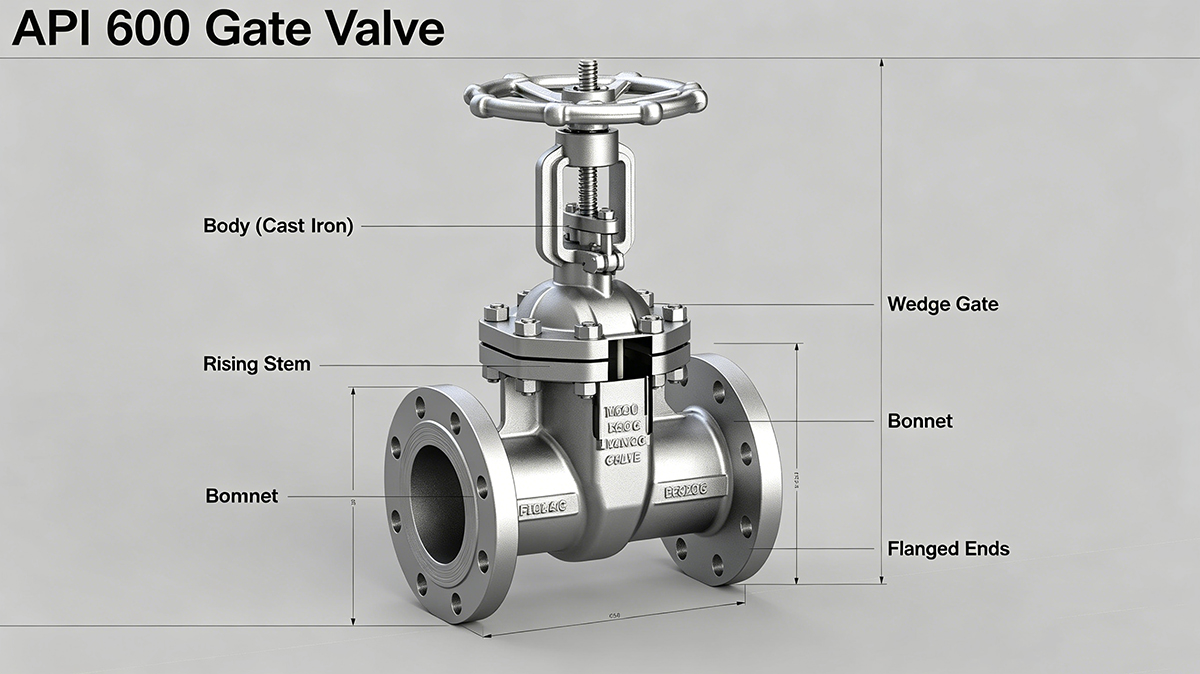
An API 600 gate valve is a bolted-bonnet, cast-steel gate valve conforming to API Standard 600 — Bolted Bonnet Steel Gate Valves for Petroleum and Natural Gas Industries. First issued by the American Petroleum Institute (API), this standard governs design, materials, dimensions, testing, and marking of gate valves used in demanding process conditions.
The "gate" refers to the closure element — a wedge-shaped disc that moves perpendicular to the flow path. When fully open, the gate retracts completely into the bonnet, delivering a full-bore, unobstructed flow path with minimal pressure drop. This makes API 600 gate valves ideal for isolation applications where zero flow restriction is critical.
Key characteristics:
Why it matters: The API 600 standard ensures interchangeability across manufacturers — a major advantage for plant operators maintaining large inventories of valves across multi-vendor piping systems.
Summary: API 600 gate valves are the industry benchmark for cast-steel isolation valves, offering standardized performance from Class 150 to Class 2500 across critical industrial pipelines.
API 600 gate valves are classified by wedge design, stem configuration, and end connection type. Understanding each type is essential for correct specification.
1. Solid Wedge Gate Valve
The most common type. The gate is a single, rigid wedge-shaped disc machined to match the valve seat angle.
2. Flexible Wedge Gate Valve
A one-piece wedge with a peripheral cut that allows slight flexing to conform to seat irregularities caused by thermal expansion.
3. Split Wedge (Double Disc) Gate Valve
Two separate discs held together by a spreader mechanism. Each disc can independently align with its seat.
| Wedge Type | Best For | Key Advantage |
|---|---|---|
| Solid Wedge | Water, oil, non-condensing steam | Simple, low cost |
| Flexible Wedge | High-temp steam, thermal cycling | Prevents sticking |
| Split Wedge | Dry gas, light hydrocarbons | Self-aligning |
Rising Stem (OS&Y — Outside Screw & Yoke)
The stem rises visibly above the handwheel as the valve opens, providing a clear visual indication of valve position.
Non-Rising Stem (NRS)
The stem rotates but does not rise. The gate travels up and down on internal threads.
| Connection Type | Standard | Typical Application |
|---|---|---|
| Raised Face Flange (RF) | ASME B16.5 / B16.47 | General process piping |
| Ring-Type Joint (RTJ) | ASME B16.5 | High-pressure oil & gas |
| Butt-Weld (BW) | ASME B16.25 | Refineries, high-cycle service |
| Socket-Weld (SW) | ASME B16.11 | Small-bore (<2") piping |
| Threaded (NPT) | ASME B1.20.1 | Low-pressure utility lines |
Summary: The three main wedge types — solid, flexible, and split — each address distinct service conditions. Stem type and end connection are chosen based on installation geometry and pipeline standards.
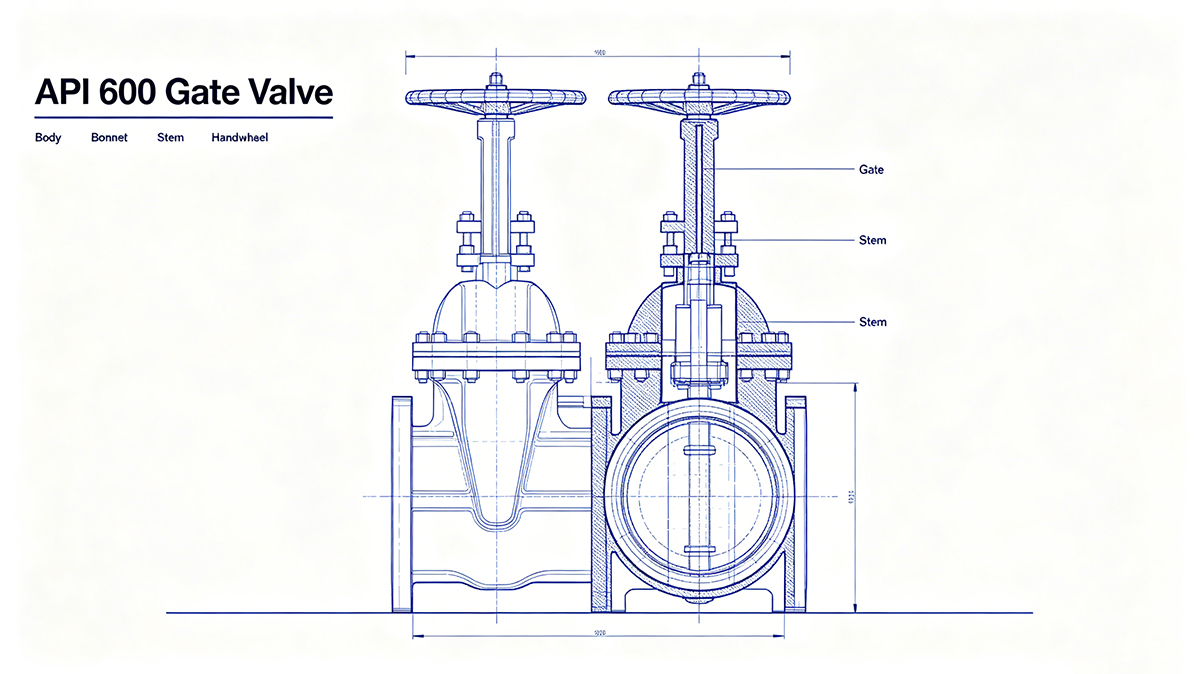
API 600 gate valves must satisfy multiple international standards:
| Specification Type | Standard |
|---|---|
| Design & Dimensions | API 600 / ASME B16.34 |
| Face-to-Face Dimensions | ASME B16.10 |
| Flanged Ends | ASME B16.5 (≤NPS 24), ASME B16.47 (>NPS 24) |
| Butt-Weld Ends | ASME B16.25 |
| Testing & Inspection | API 598 |
| Fire Testing (Optional) | API 607 / ISO 10497 |
| Positive Material ID | ASME/API PMI requirements |
| Pressure Class | Max. Working Pressure (WCB) | Typical Application |
|---|---|---|
| Class 150 | 285 PSI (19.6 bar) | Water, HVAC, utilities |
| Class 300 | 740 PSI (51 bar) | Chemical process, mid-range gas |
| Class 600 | 1,480 PSI (102 bar) | Power plant steam lines |
| Class 900 | 2,220 PSI (153 bar) | Upstream oil & gas |
| Class 1500 | 3,705 PSI (255 bar) | High-pressure gas processing |
| Class 2500 | 6,170 PSI (425 bar) | Extreme-service thermal power |
Size range: NPS 1" to NPS 42" (DN 25 to DN 1050)
Body materials:
| Material | Designation | Service |
|---|---|---|
| Carbon Steel | ASTM A216 WCB | General service, oil & gas |
| Low-Temperature Carbon Steel | ASTM A352 LCB/LCC | Down to -46°C, LNG terminals |
| Alloy Steel (1¼Cr-½Mo) | ASTM A217 WC6 | High-temp steam up to 540°C |
| Alloy Steel (2¼Cr-1Mo) | ASTM A217 WC9 | Hydrogen service, reformers |
| Stainless Steel | ASTM A351 CF8M | Corrosive chemical service |
| Duplex Stainless Steel | Duplex 2205 / Super Duplex | Offshore, chloride environments |
Trim materials:
Packing materials: Flexible graphite (standard), PTFE (low-temperature service)
Summary: API 600 gate valves combine standardized dimensions, proven material grades, and rigorous testing (API 598) to deliver consistent, long-service performance across Class 150 to Class 2500 applications.
API 600 gate valves are the standard isolation valve in wellheads, manifolds, and gathering systems. In pipeline applications, they provide reliable shutoff with zero leakage in Class 600 to Class 1500 configurations.
This is the original design application for API 600. Refineries rely on these valves throughout distillation columns, catalytic cracking units, and hydrotreater systems.
High-temperature flexible wedge models serve critical isolation duties in:
Stainless steel (CF8M) and duplex variants handle:
Carbon steel Class 150/300 models for:
Summary: API 600 gate valves are deployed across oil & gas, refining, power, petrochemical, and water treatment sectors wherever reliable on/off isolation, full-bore flow, and standardized performance are required.
Follow this 7-step selection framework to avoid misspecification:
Step 1 — Define Operating Conditions Confirm maximum operating pressure (MOP), design pressure, maximum temperature, and cyclic thermal conditions. These determine the pressure class and body material.
Step 2 — Select the Correct Pressure Class Map operating pressure to the appropriate ASME class (150 through 2500) using ASME B16.34 pressure-temperature tables. Always include a safety margin of at least 10% above MOP.
Step 3 — Choose the Body Material
Step 4 — Select the Wedge Type
Step 5 — Specify the End Connection Match your pipeline flanging standard: RF flanges for most process applications, RTJ for Class 900 and above, butt-weld for permanent high-cycle service joints.
Step 6 — Choose the Operator Type Small valves (≤NPS 6): handwheel. Larger valves: gear operator. Automated systems: electric actuator (EIM, AUMA, Rotork) or pneumatic actuator with positioner.
Step 7 — Verify Certification and Documentation Requirements Request API 600 certification, material test reports (MTRs), NDT reports, hydrostatic test records, and third-party inspection (TPI) certs (Lloyd's, BV, DNV, SGS) as required by your project specification.
Pro Tip: For sour service (H₂S environments), specify trim materials per NACE MR0175/ISO 15156 to prevent sulfide stress cracking.
The API 600 gate valve market is served by a mix of global OEMs and specialized regional manufacturers. Here are key suppliers to evaluate:
| Manufacturer | Country | Strengths | Notable Certifications |
|---|---|---|---|
| Lianggu Valve (CHLG) | China | Full-range API/GB, DN50–DN2000, low-temperature & high-pressure models, 24-hr response | API 600, API 6D, API 598, ISO 9001, SIL, PED |
| Velan Inc. | Canada / USA | Engineered-to-order, nuclear-grade, Class 2500 capability | API 600, ASME III, PED |
| Flowserve | USA | Global MRO support, large bore, fire-tested models | API 600, API 607, ISO 10497 |
| Cameron (SLB) | USA | Upstream oil & gas, premium sour-service trims | API 600, NACE MR0175 |
| KSB | Germany | Power generation specialists, steam-optimized designs | API 600, EN 12516, TÜV |
| Neway Valve | China | High-volume supply, API 6D/API 600 dual-standard | API 600, ISO 9001, PED |
| Bray International | USA | Automated valve packages, actuator integration | API 600, ISO 5211 |
How to evaluate a supplier:
Note: Lianggu Valve (CHLG) at chlgvalve.com supplies API 600 gate valves in sizes up to DN 2000, with full documentation support including ITP, NDT reports, material certificates, and calibration certificates.
API 600 gate valve pricing varies significantly based on:
| Size | Estimated Range (USD, Ex-Works) |
|---|---|
| NPS 2" | 400 |
| NPS 4" | 900 |
| NPS 6" | 1,800 |
| NPS 10" | 5,000 |
| NPS 16" | 12,000 |
| NPS 24" | 30,000 |
Prices are indicative only. Final pricing depends on material heat, pressure testing, inspection scope, and Incoterms.
Buyer tip: For EPC project procurement, always compare total landed cost (including documentation, lead time, and logistics) rather than ex-works price alone. Chinese manufacturers like CHLG often offer 30–50% cost savings with equivalent API compliance.
Q1: What is the difference between API 600 and API 6D gate valves?
API 600 covers bolted-bonnet cast-steel gate valves specifically designed for petroleum refinery service, typically for larger Class ranges. API 6D is a pipeline specification covering ball valves, check valves, and gate valves used in oil and gas transmission pipelines. They have different design priorities, testing protocols, and dimensional standards — always confirm which applies to your project specification.
Q2: Can API 600 gate valves be used for flow control (throttling)?
No. API 600 gate valves are strictly isolation valves — designed to be fully open or fully closed. Using them in a partially open (throttling) position causes severe erosion on the gate and seats, reducing service life dramatically. For flow control, use a globe valve or a control valve.
Q3: What does OS&Y mean on a gate valve?
OS&Y stands for Outside Screw and Yoke. The stem thread is located outside the valve body — as the handwheel is turned, the threaded stem rises visibly above the yoke. This provides a clear visual indicator of valve position and protects the stem threads from corrosion by process fluids.
Q4: What is the difference between a rising stem and a non-rising stem API 600 gate valve?
A rising stem (OS&Y) valve has a stem that extends upward as the valve opens, giving a visual indication of position. A non-rising stem valve rotates but does not extend — the gate moves internally on a threaded stem. Non-rising stems are used where headroom is limited (underground, buried pipelines, valve pits).
Q5: How are API 600 gate valves tested?
All API 600 gate valves must pass three tests per API 598:
Q6: What materials are suitable for sour gas (H₂S) service?
For sour service applications, specify body, bonnet, and trim materials compliant with NACE MR0175 / ISO 15156. Typical selections: WCB body with 13Cr stem, Inconel 625 or Stellite seats, and PTFE or graphite packing. Avoid high-hardness steels susceptible to sulfide stress cracking (SSC).
Q7: What is a flexible wedge and when should I use it?
A flexible wedge is a one-piece gate with a peripheral groove machined around the circumference. This groove allows the wedge to flex slightly, ensuring full contact with both valve seats even when seats have been distorted by thermal expansion or piping loads. Use flexible wedges for high-temperature steam service (above 300°C), thermal cycling conditions, or where valve sticking has been a historical problem.
Q8: What is the typical lead time for API 600 gate valves from Chinese manufacturers?
Standard carbon steel (WCB) API 600 gate valves in Class 150–600 are typically available from stock or within 4–8 weeks for standard sizes. Large-bore valves (NPS ≥ 16"), high-pressure classes (1500/2500), or exotic material grades (Duplex, Monel) require 8–16 weeks for manufacture and testing. Expedited schedules may be available for EPC priority projects.
API 600 gate valves remain the backbone of isolation service in petroleum refining, oil & gas pipelines, power generation, and chemical processing worldwide. Selecting the right valve — correct pressure class, wedge type, material grade, and actuation — directly impacts plant safety, uptime, and maintenance costs.
Lianggu Valve Group (CHLG) manufactures a comprehensive range of API 600-compliant gate valves: