

Date:2026-06-17 Views:16
An AWWA C500 gate valve is a metal-seated shut-off valve designed for water supply and distribution service, manufactured in accordance with the American Water Works Association standard ANSI/AWWA C500. The standard covers gate valves in sizes 3 inch through 48 inch (DN80–DN1200), rated at 150–300 psi working pressure, with bronze-on-bronze or bronze-on-iron seating surfaces and ductile iron or cast iron bodies. These valves are engineered for full-open or full-close isolation duty in municipal waterworks systems.
Municipal water systems worldwide move billions of gallons of water every day. The valves controlling that flow must perform reliably for decades underground, exposed to variable pressure, seasonal ground movement, and water containing sediment or minerals.
The global Gate Valve Market is valued at 17.69 billion by 2035, driven by aging water infrastructure replacement programs in North America and Europe, and rapid urbanization across Asia-Pacific (Mark Wide Research, 2026). Water and wastewater valves alone represent a **18.6 billion by 2033 at a CAGR of 4.6% (Verified Market Reports).
Within this landscape, AWWA C500 metal-seated gate valves remain a critical specification. They are engineered for on/off isolation service and handle conditions — particularly water with particulates — where resilient-seated valves may be damaged. Engineers, utility procurement managers, and contractors specifying valves for large-diameter transmission mains, pump stations, and treatment plant headers frequently turn to C500 for its durability and proven field record.
This guide covers everything you need to know: definitions, design types, technical specifications, application scenarios, a comparison with AWWA C509/C515 standards, and a buying guide with manufacturer recommendations.
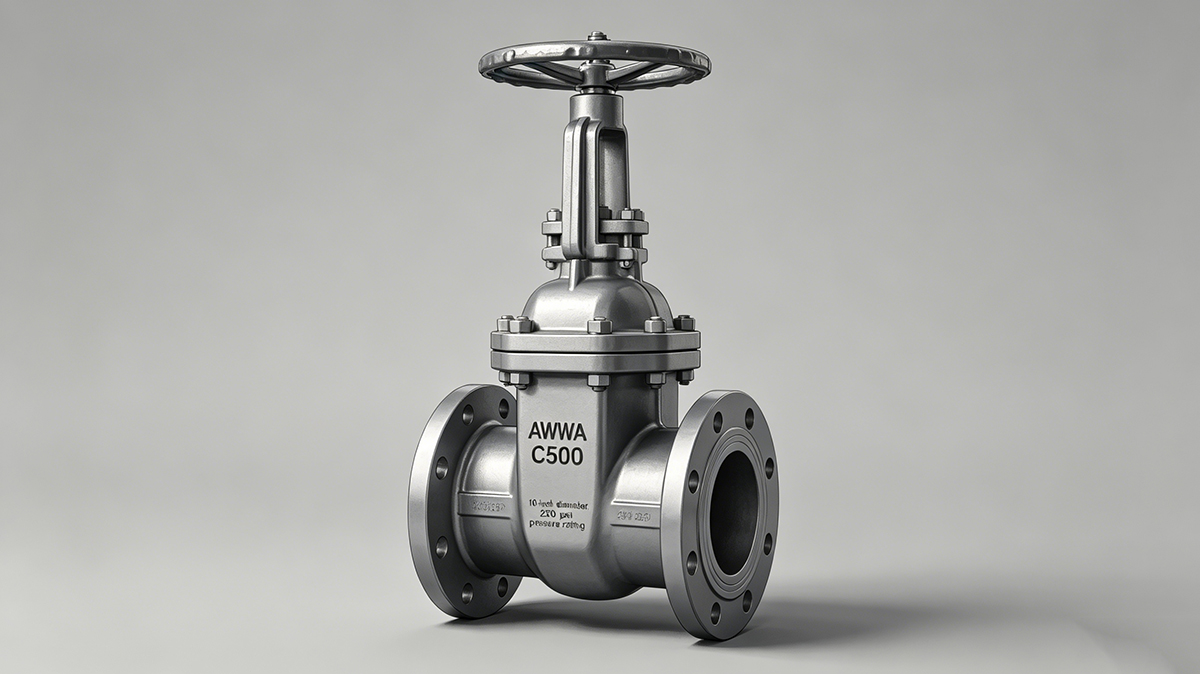
An AWWA C500 gate valve refers to a full-bore, metal-seated sliding gate valve conforming to the ANSI/AWWA C500 standard (Metal-Seated Gate Valves for Water Supply Service). First published in 1913 and most recently revised in 2019 (AWWA C500-19), this standard defines the minimum requirements for design, materials, testing, inspection, and marking.
The valve operates by moving a disc (gate) perpendicular to fluid flow. In the fully open position, the gate retracts completely into the bonnet cavity, creating a full-bore, unobstructed flow path with minimal pressure drop. In the fully closed position, the gate wedges against bronze seat rings machined into the valve body.
Key characteristics:
AWWA C500 is one of three AWWA gate valve standards commonly specified in North America:
| Standard | Seating Type | Body Material | Zero Leakage | Typical Size Range |
|---|---|---|---|---|
| AWWA C500 | Metal-seated | Ductile/Cast Iron | No (spec. limits) | 3"–48" |
| AWWA C509 | Resilient-seated | Ductile/Cast Iron | Yes | 3"–16" |
| AWWA C515 | Resilient-seated | Ductile Iron (FEA) | Yes | 3"–72" |
C515 is now the dominant modern standard for new installations, but C500 remains irreplaceable in high-pressure systems, water with suspended solids, and large-diameter replacement projects on legacy systems originally built to C500.
AWWA C500 gate valves are classified by three principal design variables: stem type, disc design, and end connection.
| Connection Type | Standard Reference | Best Application |
|---|---|---|
| Flanged — ANSI B16.1 Class 125 | ANSI/ASME B16.1 | Standard waterworks flanged systems |
| Flanged — ANSI B16.5 Class 150 | ANSI/ASME B16.5 | Higher-pressure industrial water systems |
| Mechanical Joint (MJ) | AWWA C111 | Underground ductile iron or PVC piping |
| Plain End (PE) | — | Welded or restrained-joint systems |
| Combination Flanged/MJ | AWWA C500 | Retrofit into mixed existing pipework |
Summary: NRS + double-disc + mechanical joint is the classic underground waterworks configuration; OS&Y + solid wedge + flanged is standard for aboveground plant service.
| Standard | Scope |
|---|---|
| ANSI/AWWA C500-19 | Primary design and material standard |
| MSS SP-70 | Supplementary iron gate valve standard (often dual-listed) |
| ANSI/AWWA C111 | Mechanical joint ends |
| ANSI/AWWA C550 | Protective interior coating (fusion-bonded epoxy) |
| NSF 61 | Drinking water system components — health effects |
| NSF 372 | Lead-free compliance |
| UL Listed | Fire service applications |
| Nominal Pipe Size (NPS) | Working Pressure | Hydrostatic Shell Test |
|---|---|---|
| 3" – 12" (DN80–DN300) | 200 psi (1,380 kPa) | 400 psi (2,760 kPa) |
| 3" – 12" (optional higher) | 300 psi (2,070 kPa) | 600 psi (4,140 kPa) |
| 16" – 48" (DN400–DN1200) | 150–200 psi (1,050–1,380 kPa) | 300–400 psi |
Note: Seat leakage tests per AWWA C500 permit a defined maximum leakage rate — typically measured in cubic centimeters per inch of seat diameter per minute — not zero-leakage as required by C509/C515.
| Component | Standard Material | Optional Upgrade |
|---|---|---|
| Body & Bonnet | Ductile iron ASTM A536 | Gray iron ASTM A126 Class B |
| Disc / Gate | Ductile iron ASTM A536 | Bronze-faced disc |
| Seat Rings | Bronze ASTM B62 | Stainless steel (for aggressive water) |
| Stem | Stainless steel ASTM A582 / Bronze | 316 SS for higher corrosion resistance |
| Packing | PTFE / Graphite | — |
| Fasteners | Stainless steel or zinc-plated carbon steel | A193 B8M (fully corrosion-resistant) |
| Interior Coating | Fusion-bonded epoxy per AWWA C550 | NSF 61-certified epoxy |
| Exterior Coating | Epoxy primer + topcoat | Polyurethane for buried service |
AWWA C500 metal-seated gate valves are specified across the full water infrastructure lifecycle:
The primary application. Gate valves installed at line intersections, hydrant branches, and service connections allow crews to isolate main breaks without disrupting the entire network. Sizes 4"–16" NRS are the most common underground water main isolation valves.
OS&Y flanged gate valves control flow at filter influent and effluent headers, sludge withdrawal lines, and chemical feed flush systems. The ability to visually confirm valve position is critical in treatment plant environments.
C500 gate valves are installed on suction and discharge headers of pump trains. Their low pressure drop in full-open position reduces pump energy consumption. OS&Y design is preferred here for clear open/close visual indication.
Large-diameter C500 gate valves (16"–48") control flow out of ground-level and elevated storage tanks. The metal-seated design is specified when water quality includes fine sediment that could damage rubber resilient seats.
UL-listed AWWA C500 gate valves are installed on fire mains feeding hydrants and sprinkler supply risers. The metal-seated construction provides reliable shut-off after decades of standby service between activations.
Industrial cooling water circuits, process water supply, and agricultural irrigation systems all use C500 gate valves where water may contain suspended solids or where maintenance access is infrequent.
Application rule: AWWA C500 is the correct specification when water velocity does not exceed 16 ft/sec (4.9 m/s) at the fully open position, and when the installation orientation is approximately level.
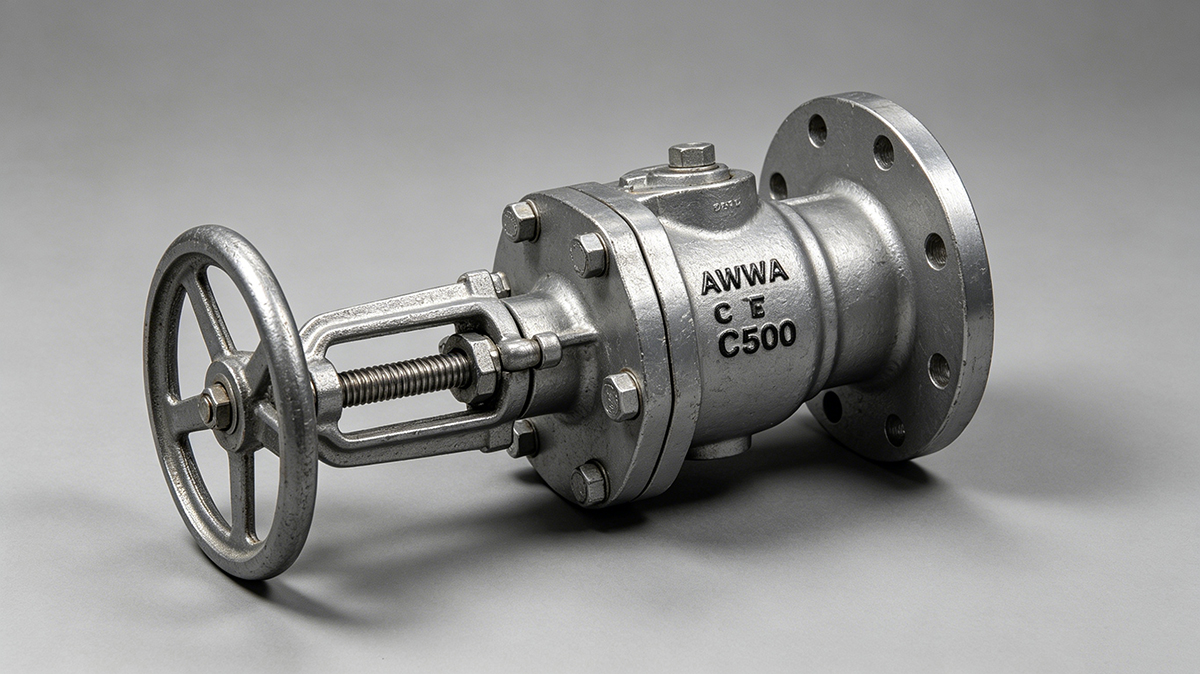
| Comparison Factor | AWWA C500 | AWWA C509 | AWWA C515 |
|---|---|---|---|
| Seating Type | Metal (bronze-on-bronze) | Resilient (rubber-encapsulated disc) | Resilient (rubber-encapsulated disc) |
| Zero Leakage | No (defined limits) | Yes | Yes |
| Body Material | Ductile or gray iron | Ductile or gray iron | Ductile iron only |
| Wall Thickness Design | Prescriptive (arbitrary) | Prescriptive (arbitrary) | FEA-optimized |
| Max Working Pressure | 200–300 psi | 200 psi | 250 psi |
| Typical Size Range | 3"–48" | 3"–16" | 3"–72" |
| Pressure at Corosion Test | — | Permanent deformation at ~1,200 psi | Recovers elastically at ~1,200 psi |
| Best for Dirty Water | ✅ Yes | ⚠️ Limited | ⚠️ Limited |
| Modern Standard Preference | Legacy/specialty | Legacy | ✅ Primary modern standard |
| Maintenance | Seat refacing possible | Replace disc/seat | Replace disc/seat |
| Operating Torque | Higher | Lower | Moderate |
Summary: AWWA C500 is not obsolete — it is the correct specification for specific technical conditions. C515 is the modern default for new construction; C500 fills the technical gap where metal seating and higher pressure are needed.
Selecting the wrong valve specification is costly. Use this structured decision framework:
1. Confirm the Applicable Standard Verify the project specification calls for AWWA C500 (metal-seated). If the spec is silent, confirm with the engineer of record whether metal or resilient seating is preferred. Do not substitute C509/C515 for C500 without approval.
2. Determine Size and Pressure Rating
3. Select Stem Type
4. Choose End Connection
5. Verify Material and Coating
6. Confirm Testing and Certification
7. Evaluate Long-Term Total Cost of Ownership (TCO)
Pro Tip: Always specify the required operator type (handwheel, nut, gearbox, or actuator) in your purchase order. For sizes 12" and larger, a gear operator is recommended to reduce operating torque to safe levels per AWWA C500.
The following manufacturers produce gate valves meeting AWWA C500 and MSS SP-70 standards:
| Manufacturer | Country | Sizes Available | Notable Certifications | Strength |
|---|---|---|---|---|
| CHLG Lianggu Valve Group | China | 2"–48" | ISO 9001, API, CE | Full-range industrial & water gate valve manufacturing |
| Mueller Water Products | USA | 4"–48" | NSF 61/372, UL, FM | Dominant North American waterworks supplier |
| American Flow Control (ACIPCO) | USA | 3"–48" | NSF 61/372, UL, FM | Ductile iron pipe system integration |
| Kennedy Valve (McWane) | USA | 3"–48" | NSF 61, UL | Full waterworks valve range; OEM replacement |
| Val-Matic Valve | USA | 2"–48" | NSF 61/372, UL, FM | Engineering expertise; actuation solutions |
| VAHN-TECH International | Canada | 2"–24" | NSF 61/372, UL | Export-focused; serves 16+ countries |
| Deye Piping | China | 3"–36" | ISO 9001, NSF 61 | Competitive pricing; AWWA export specialist |
When shortlisting vendors, verify:
About CHLG Lianggu Valve Group: Headquartered in Lianggu Industrial Park, China, CHLG (chlgvalve.com) integrates product design, pattern and tooling, casting, machining, assembly, and performance testing under one roof. Their gate valve range covers industrial and waterworks applications with export certifications including API, ISO 9001, and CE. CHLG serves buyers and distributors across oil & gas, municipal water, and chemical processing sectors globally.
AWWA C500 gate valve pricing varies substantially by size, material, stem type, and manufacturer origin. The following ranges reflect 2026 market pricing for standard flanged NRS configuration with FBE coating:
| Size (NPS) | Budget Range (FOB China) | Mid-Range (FOB USA/EU) | Premium (US Manufacturer) |
|---|---|---|---|
| 3" (DN80) | 150 | 400 | 800 |
| 4" (DN100) | 200 | 550 | 1,100 |
| 6" (DN150) | 320 | 900 | 2,000 |
| 8" (DN200) | 500 | 1,400 | 3,500 |
| 10" (DN250) | 700 | 2,000 | 5,500 |
| 12" (DN300) | 950 | 2,800 | 8,000 |
| 16" (DN400) | 1,800 | 5,000 | 14,000 |
| 20" (DN500) | 2,800 | 8,500 | 22,000 |
| 24" (DN600) | 4,500 | 13,000 | 35,000 |
| 30"–36" | 9,000 | 22,000 | 60,000 |
| 42"–48" | 18,000 | 40,000 | 100,000+ |
Eight variables drive final AWWA C500 gate valve cost:
Buyer Tip: For large municipal projects, request total landed cost including freight, customs duty (typically 3–5% in the US for ductile iron valves), and local inspection costs. A lower ex-works price from overseas may not always yield the lowest project cost.
Q1: What does AWWA C500 mean on a valve specification? AWWA C500 is the American Water Works Association standard covering metal-seated gate valves for water supply service. It sets minimum requirements for design, materials, pressure testing, dimensions, and marking. When a project spec calls for "AWWA C500 gate valve," it requires metal-seated construction — not resilient-seated — conforming to the 2019 edition of this standard.
Q2: Can I substitute an AWWA C509 or C515 valve where AWWA C500 is specified? Not without engineering approval. C509 and C515 are resilient-seated designs that achieve zero leakage but are typically rated to 200 psi and may not handle water with suspended solids as well as C500. Always get written approval from the engineer of record before substituting standards; improper substitution can void project compliance and void the valve warranty.
Q3: What is the difference between NRS and OS&Y in an AWWA C500 gate valve? NRS (Non-Rising Stem) valves keep the stem compact — ideal for underground installation where vertical space is limited. The disc travels on the rotating stem internally. OS&Y (Outside Screw and Yoke) valves raise the stem visibly above the packing gland when opened, giving operators an immediate visual position indicator. OS&Y is preferred for aboveground and fire service applications.
Q4: Are AWWA C500 gate valves suitable for potable (drinking) water? Yes, when the valve carries NSF 61 and NSF 372 (lead-free) certification. The NSF 61 certification confirms that all wetted components — including the body, seat rings, coating, and stem materials — do not leach harmful levels of contaminants into drinking water. Always verify the NSF certification number on the NSF online database before specifying or accepting delivery.
Q5: What pressure can an AWWA C500 gate valve handle? Standard AWWA C500 gate valves are rated at 200 psi working pressure for sizes 3"–48". An optional 300 psi pressure class is available for sizes 3"–12". The hydrostatic shell test pressure is twice the working pressure. Consult the manufacturer for systems operating above 200 psi.
Q6: How long do AWWA C500 metal-seated gate valves last? With proper installation, operation, and periodic exercising (opening and closing annually), metal-seated gate valves commonly achieve service lives of 30–50 years or more. Bronze seat rings can be refaced in-situ if wear develops, avoiding full valve replacement. This longevity is a major advantage over resilient-seated valves, where elastomer degradation may require disc replacement every 15–20 years.
Q7: What causes AWWA C500 gate valves to fail? Common failure modes include: (1) Corrosion of the stem if packing is not maintained; (2) Seat wear from throttling — these are on/off valves and must never be used for flow regulation; (3) Wedge jamming if the valve is left partially open for extended periods; (4) Interior tuberculation if fusion-bonded epoxy coating is damaged. Annual valve exercising and inspection programs prevent most failures.
Q8: What is the lead time for large AWWA C500 gate valves? For sizes 3"–12", stock items from major manufacturers are typically available within 2–4 weeks. For sizes 16"–24", expect 6–10 weeks from order. For sizes 30"–48", plan for 10–16 weeks production lead time. Gear operators and actuator mounting add 2–4 weeks. Factor these lead times into project schedules early.
AWWA C500 metal-seated gate valves represent over a century of proven performance in water supply infrastructure. While AWWA C515 resilient-seated valves are the modern standard for most new construction, C500 remains the specification of choice where metal seating is required — particularly in high-pressure zones, large-diameter transmission systems, and environments where water quality includes suspended solids that could damage rubber seats.
Key specification priorities: confirm body material (ductile iron ASTM A536), stem type (NRS vs OS&Y), end connection (flanged or MJ), interior coating (FBE per AWWA C550), and certifications (NSF 61/372 for potable water, UL for fire service). Always test the valve against the AWWA C500-19 hydrostatic and seat leakage requirements before accepting delivery.
CHLG Lianggu Valve Group offers a comprehensive range of gate valves engineered to AWWA C500 and MSS SP-70 standards. Our manufacturing capabilities span:
📩 Request a quote: Visit chlgvalve.com or contact our technical sales team. Specify valve size, pressure class, stem type, and quantity — we respond within 24 hours.
Explore related products: